


and brought its wounded soldiers to the temporary military hospitals in Sisak.
About the cemetery

As a place of residence, Sisak has existed for
over two thousand years. The Illyrians, then the Celts, then the
Romans, and finally the Slavs, lived in this region. At each period, people
lived and died, so all cultures had to have a burial place.
Burial on hill Viktorovac began in 1878 when Austro-Hungary occupied
Bosnia and brought its wounded soldiers to the temporary military hospitals
in Sisak. About a hundred wounded soldiers died in Sisak. The first
deceased, Ladislav Barboc, a Vienna-based driver, died on August 29, 1878.
He was buried near the Church of the Blessed Virgin Mary in Viktorovac. This
grave no longer exists.

By 1891 the deceased Orthodox were buried in the cemetery in Petrinja. Due to the distance and poor traffic, in 1891 the
Orthodox Church in Sisak purchased 2 acre from the
Church of St. Mary as “the land for burial of Sishtians of Orthodox
faith”. A fee was paid for each burial to the Church of the Blessed
Virgin Mary. From that year, the existence of a
cemetery in Viktorovac is calculated.
In the Victorian cemetery, about a hundred meters northwest of the
church of St. Mary, there was also an Orthodox chapel of Sts. Petka.
Orthodox were buried in front of this chapel, which is still visible today
from the old tombstones.
The completion of the first Sisak hospital building, on December 29, 1896,
is of great importance in the expansion of the cemetery. In
1897, in order to have the dead buried, the city magistrate of Sisak
bought most of the land of the Church of the Blessed Virgin Mary where
the city cemetery was then founded. In the 1940s, a
morgue was built, and a fence area was enclosed. At that time,
part of the cemetery was arranged for the German soldiers (about 540 graves). Now there is a common ossuary at this
place with the remains of German soldiers.

With the end of World War II, cemeteries became “socially owned”. The
People’s Committee of the Municipality of Sisak decided (May 17, 1960) on
the expropriation of one acre and 1045 square feet of land from the Church
of the Blessed Virgin Mary in Viktorovac for the needs of the city cemetery.
The Cemetery was
initially taken care of by the City Plantation Company.
By the decision of the Sisak City Administration in 1952, burials in the
cemetery of Sv. Kvirin could only be performed in the tombs, and
since 1960 the burials in that cemetery has ceased altogether. At the
end of the 1960s, the city government informed the public that they should
exhume their dead and
move their remains to the Viktorovac City Cemetery, as a park would
be arranged on that part. Some of the graves were moved to a new location
(Viktorovac), but most of the
monumental (Jewish) tombstones were demolished.
Important monuments and parts of the cemetery

Monument to the Flag
The “Zastava” (Flag) Monument is a monumental work of the renowned academic
sculptor Antun Augustinčić and has original function and design, as
well as artistic, aesthetic, and ambient value. It erected in 1965 in honor of the fallen soldiers and victims of fascist terror in the Sisak municipality and it is located on the elevation of the
central part of the Viktorovac City Cemetery in Sisak.
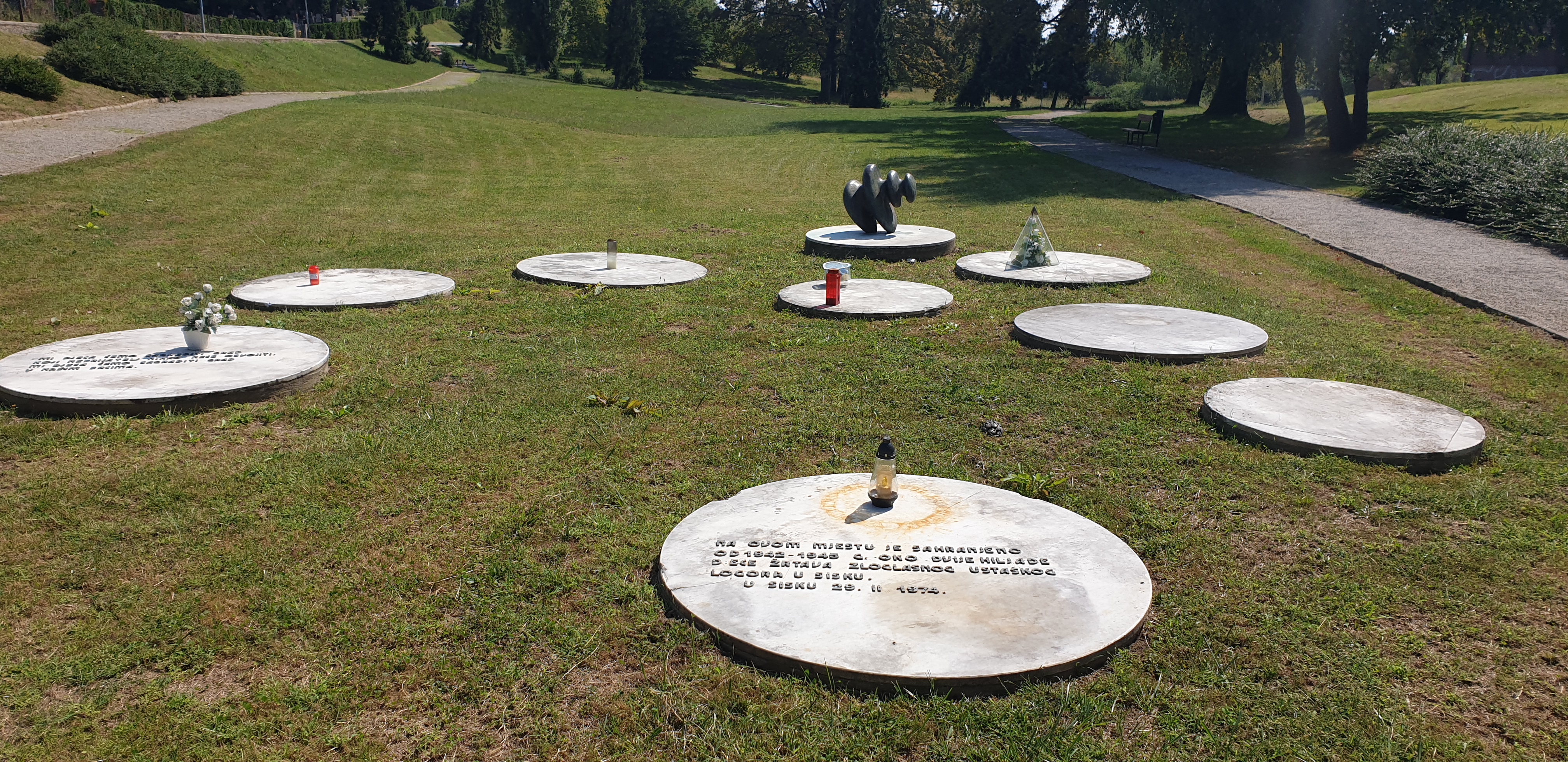
Viktorovac Children’s Cemetery
The memorial site for the Children’s Cemetery is located in Antun Kovačić
Street in Sisak, opposite the Viktorovac City Cemetery. The monument at the
site of the Sisak Children’s Cemetery was
erected in 1974 in honour of the children who died in the Sisak
Children’s Camp during the World War II. The monument is authored by academic sculptor Milena Lah. The
conceptual design of the children’s cemetery was designed by
landscape architect Mira Wenzler.

German Military Cemetery
Near the cemetery Church of St. Mary, the old part of Viktorovac is
dominated by a façade brick, lined with high concrete pillars at the
entrance to the German military cemetery – “Militaerfriedhof”. There
are six stylized German military crosses and a
Book of memories that contains the names of dead German soldiers
killed in II World war.

Sava Victims Cemetery
Sava Vistims Cemetery is a common burial ground for the inhabitants
of Sisak and the surrounding area, who were
killed by the Germans and Ustashas just hours before the Partisans
entered, on May 5, 1945. The monument, the stylization of dead bodies
floating on the water, was made by an
academic sculptor Siščanin Želimir Janeš, who also designed the
conceptual and artistic design of the whole complex. The monument was
erected on November 29, 1956.
Important personalities at the cemetery

Some of the important personalities buried at the Viktorovac City
Cemetery are:
-
Aleksandar Vernak – pharmacist who opened first pharmacy
in Military Sisak in 1864 - Miroslav Knight Mlikowsky De Lhota – doctor and ranger
- Franjo Lovrić – first mayor of Sisak
- Family Šipuš Sisački (Nikola, Milan, Matija, Marta)
-
Mr. Ph. Romeo (Romualdus) Pl. Renaldy – one of the oldest
pharmacists from Sisak - Ferdo Hefele – educator and ethnographer
-
Vlado Janić Capo – activist, member of the Central Committee
of the KPH and the Central Committee of the KPJ - Slavo (Slavoljub) Striegl – Croatian painter
- Marijan Glavnik – Sisak academic sculptor and painter
-
Tea Benčić Rimay – Croatian poet, essayist, and literary
theorist - Franjo Medricky – composer and choirmaster
-
Janko Bobetko – member of the KPH, General of the
Croatian Armed Forces, and Chief of the General Staff of the Armed Forces
of the Republic of Croatia from 1992 to 1995
Address
Viktorovac City Cemeteries d.o.o.
Antuna Grahovara 2
Sisak
Croatia
Basic data
Ownership: City of Sisak, Croatia
Cemetery size in m2: 124.970 m2
Number of graves:11.852